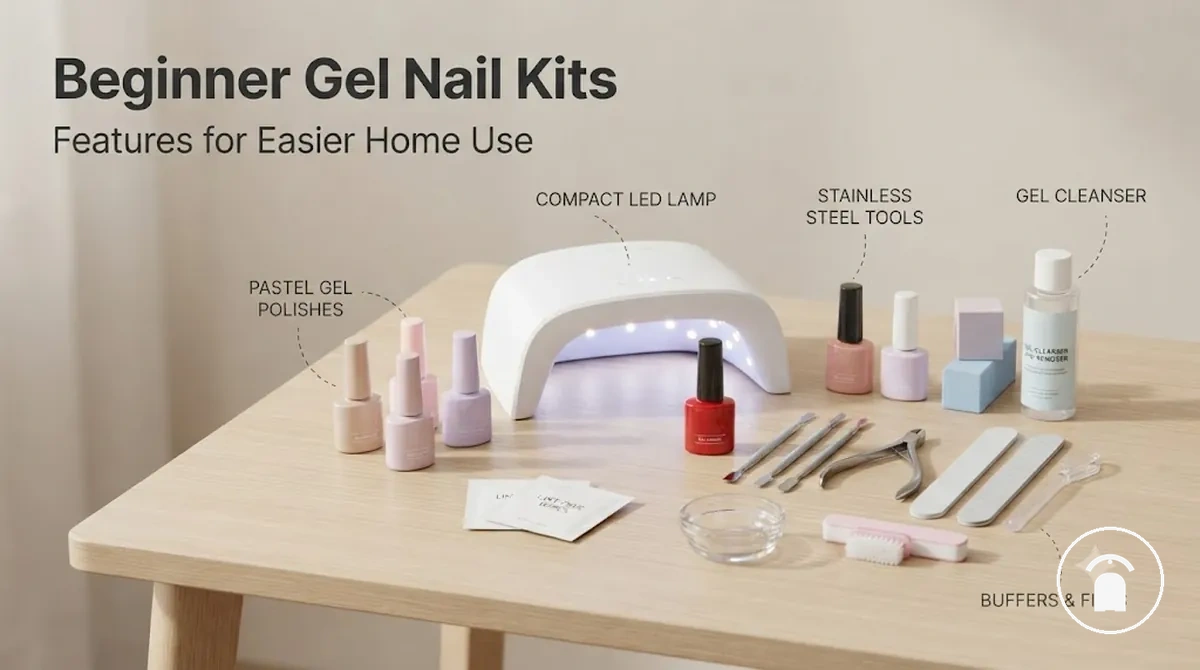
Beginner Gel Nail Kits for Easier Home Manicures
Beginner gel nail kits are starter-focused manicure kits selected for easier home manicures by combining the basic components needed for gel polish application, including gel polish, a UV/LED lamp, and prep tools. The main selection factor is whether the kit provides a manageable learning curve through suitable contents, clear guidance, and a simple curing process for first-time users.
Beginner gel nail kits suit users who want a structured way to learn home manicures rather than a complex system designed for advanced nail techniques.
Beginner gel nail kits suit users who want a structured way to learn home manicures rather than a complex system designed for advanced nail techniques. gel nail kits for home use can contain different combinations of gel polish, a UV/LED lamp, prep tools, and removal supplies, so the kit contents should be matched to the user's intended use. A starter kit with the required basics and understandable instructions can reduce uncertainty during early practice, while extension-focused kits may introduce additional tools and techniques that increase the learning curve.
The main criteria for choosing beginner gel nail kits are kit completeness, lamp simplicity, gel polish system complexity, prep tool availability, instruction quality, and overall value.
The main criteria for choosing beginner gel nail kits are kit completeness, lamp simplicity, gel polish system complexity, prep tool availability, instruction quality, and overall value. A kit that groups the necessary components together can make the preparation, curing, and removal stages easier to understand, but the final result still depends on the specific product instructions and the user's application practice.
The more suitable choice depends on whether the goal is learning basic gel colour manicures or using more advanced nail systems.
For example, a first-time user choosing between a starter kit containing gel polish, a compatible UV/LED lamp, and basic prep tools versus an extension kit containing additional shaping products and specialised tools would be comparing different learning requirements rather than simply comparing the number of included items. The more suitable choice depends on whether the goal is learning basic gel colour manicures or using more advanced nail systems.
Table of Contents
What Makes a Gel Nail Kit Beginner-Friendly
A beginner-friendly gel nail kit is a gel nail kit designed to reduce the learning burden through simple steps, suitable included tools, clear lamp guidance, and understandable instructions. The main attributes that make a gel nail kit beginner-friendly are kit completeness, manageable product complexity, and guidance that helps first-time users understand preparation, gel polish application, curing, and removal requirements.
The kit does not remove the need for practice because application results depend on preparation, product instructions, curing conditions, and user technique.
A beginner-friendly gel nail kit includes the basic components needed for the intended manicure type, such as gel polish, prep tools, and a compatible UV/LED lamp when curing is required by the polish system. The kit does not remove the need for practice because application results depend on preparation, product instructions, curing conditions, and user technique. A starter kit focused on basic colour manicures is generally different from builder-gel or extension systems because advanced systems introduce additional tools and techniques.
The checklist below verifies whether the kit provides clear guidance, essential components, and a manageable learning path.
What makes a gel nail kit beginner-friendly can be checked through practical features that reduce uncertainty during first use. The checklist below verifies whether the kit provides clear guidance, essential components, and a manageable learning path.
- Included tools: A beginner-friendly gel nail kit provides the essential tools required for its intended use, such as gel polish, nail preparation items, and curing equipment when required by the product system.
- Simple steps: A kit with a straightforward product sequence helps first-time users understand the order of preparation, polish application, curing, and removal without unnecessary complexity.
- Lamp guidance: A beginner-friendly kit provides lamp guidance that explains compatibility and curing instructions for the included gel polish system.
- Clear instructions: Readable instructions help first-time users identify product order, application requirements, and curing guidance before practising.
- Complete basics: A starter kit that includes the main items needed for a basic manicure can reduce the need to identify missing components before first use.
- Realistic practice expectations: A beginner-friendly gel nail kit supports learning, but it does not guarantee salon-style results because outcomes depend on preparation quality, technique, and following the product instructions.
Beginner-friendly does not mean that users can ignore curing requirements or handling precautions. The separate guidance on safe home use covers safety considerations, while this section focuses on the selection features that make a kit easier to learn.
Starter Kit Contents That Reduce the Learning Curve
Starter kit contents reduce the learning curve by providing first-time users with the essential components needed to understand a gel nail kit workflow, including preparation, gel polish application, curing, and removal. The beginner value of each component comes from its role in reducing uncertainty during the first uses rather than from simply increasing the number of items included.
The beginner value of each component comes from its role in reducing uncertainty during the first uses rather than from simply increasing the number of items included.
The starter kit contents should be evaluated by the purpose of each item, the beginner value it provides, and the requirements a user should check before choosing a kit. Core items such as a curing lamp, gel polish, base coat, top coat, prep tools, wipes, remover items, and instructions support different stages of the beginner manicure process.
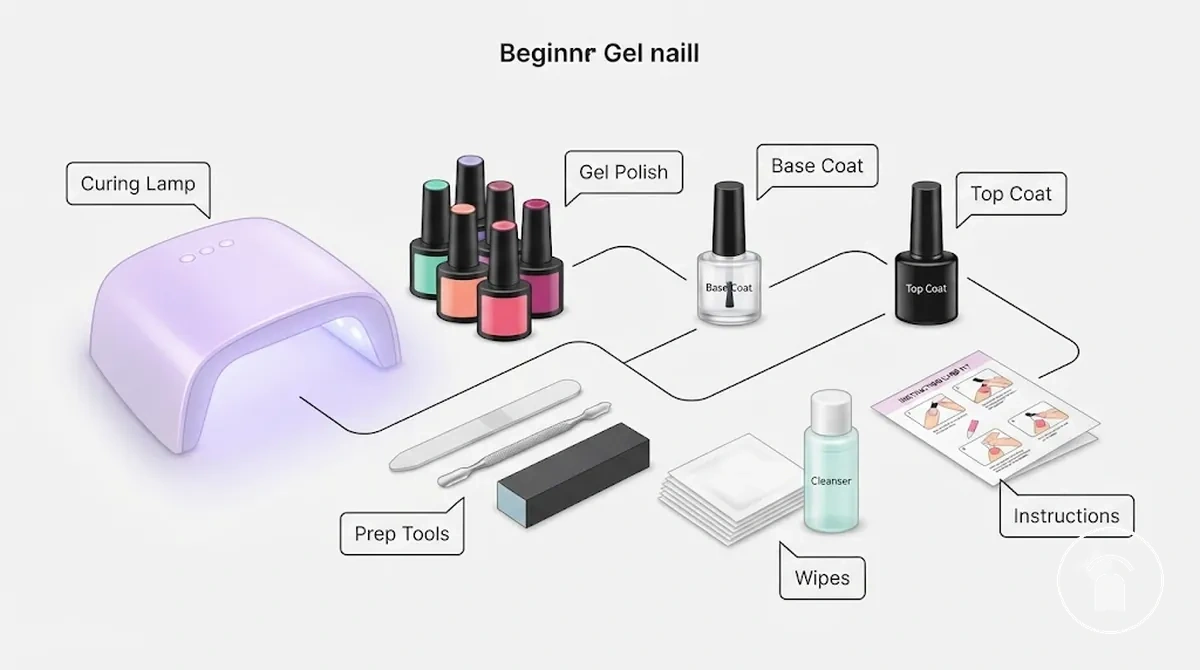
| Item | Purpose | Beginner value | What to check |
|---|---|---|---|
| Curing lamp | Provides the curing stage required by compatible gel polish systems | Helps first-time users follow a defined curing process | Check that the lamp guidance matches the gel polish instructions |
| Gel polish | Provides the colour layer used in a gel manicure system | Reduces the need to select separate polish products for the initial setup | Check the application and curing requirements for the polish system |
| Base coat | Supports the preparation layer when required by the gel polish system | Helps users understand the product sequence before colour application | Check whether the selected system requires a base layer |
| Top coat | Provides the finishing layer when required by the gel polish system | Helps beginners follow a complete product sequence | Check whether the system includes or requires a finishing layer |
| Prep tools | Prepare the nail surface before gel application | Helps users complete the preparation stage before applying gel polish | Check that the kit includes the basic preparation items needed for the intended use |
| Wipes | Support cleaning or preparation steps during the manicure process | Helps maintain an organised workflow for first-time users | Check whether wipes are included or need to be supplied separately |
| Remover items | Support gel product removal after use | Helps users consider the full use cycle beyond application | Check the removal method recommended for the gel polish system |
| Instructions | Explain product order and usage requirements | Reduces uncertainty during early practice | Check whether instructions cover preparation, curing, and removal |
Missing basics can make a first gel nail kit experience harder because users may need to identify additional tools or determine how separate products work together. A kit containing gel polish and a curing lamp but lacking clear preparation guidance may leave a first-time user uncertain about the correct sequence. A practical selection approach is to prioritise the contents that support the intended beginner workflow rather than choosing a kit only because it contains more items.
Core Items for Prep, Polish, Curing, and Removal
The core items for prep, polish, curing, and removal in a beginner gel nail kit are the components that support nail preparation, gel polish use, curing, and product removal. These core items include a file or buffer, cleanser or wipes, gel polish products, a compatible lamp, remover supplies, and supportive aftercare items when included or required by the kit system.
Each item has a specific role in reducing uncertainty for first-time users.
Each item has a specific role in reducing uncertainty for first-time users. The exact combination can vary between gel nail kits, so components such as base coat, top coat, cleanser, and remover supplies should be checked against the product instructions rather than assumed to be required for every system.
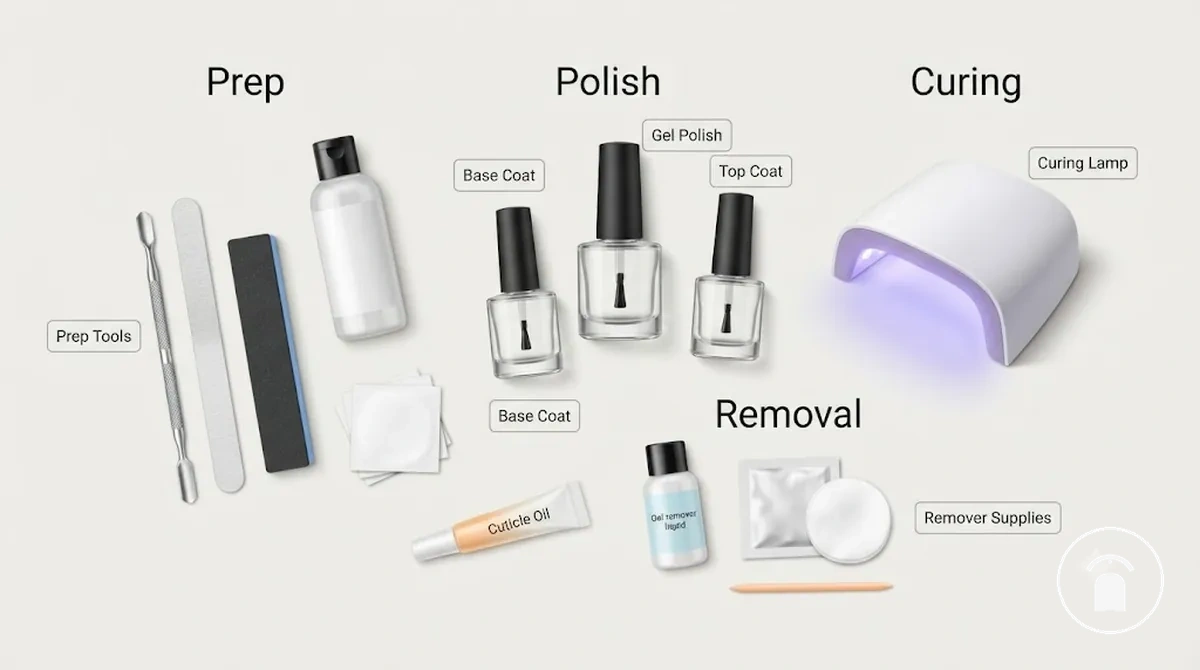
- File or buffer: A file or buffer supports prep by helping users prepare the nail surface before gel products are used. Including a suitable prep tool can reduce the need to identify separate basics before the first use.
- Cleanser or wipes: Cleanser or wipes support cleaning steps within a gel nail kit workflow when required by the product system. They help reduce uncertainty about which items are used for surface preparation or finishing tasks.
- Base coat and top coat: Base coat and top coat support the polish sequence when the selected gel system requires these layers. They help beginners recognise that different products can have different roles within a gel manicure system.
- Colour gel: Colour gel provides the visible polish layer in a gel manicure system. Beginners should check the product instructions because colour gel systems can differ in their curing and application requirements.
- Lamp: A lamp supports curing when the gel polish system requires light curing. Beginners should check lamp and gel polish compatibility because curing requirements are specific to the products being used.
- Remover supplies: Remover supplies support the removal stage after gel use. Including suitable removal items helps beginners consider the complete product cycle rather than only the initial application stage.
- Aftercare items: Aftercare items support maintenance after removal or between uses when included by the kit system. These items are supportive additions and do not replace correct preparation or removal practices.
A beginner gel nail kit does not need every possible accessory to support learning. The most useful core items are the ones that match the intended gel system and reduce uncertainty during prep, polish, curing, and removal.
Instructions, Tutorials, and Support That Help First-Time Users
Instructions, tutorials, and support features help first-time users reduce uncertainty by providing guidance about how a gel nail kit should be approached before and during use. Clear guidance can improve first-use confidence because it helps users understand product order, curing times, layer guidance, and common troubleshooting notes without relying only on guesswork.
For full application guidance, users can follow a dedicated step-by-step kit use guide after selecting a suitable kit.
Guidance features should be evaluated through visible resources such as a kit manual, readable instructions, tutorial content, curing time references, and troubleshooting notes. These resources explain how the included tools relate to each other, while the exact quality and availability of support depend on what a specific kit provides. For full application guidance, users can follow a dedicated step-by-step kit use guide after selecting a suitable kit.
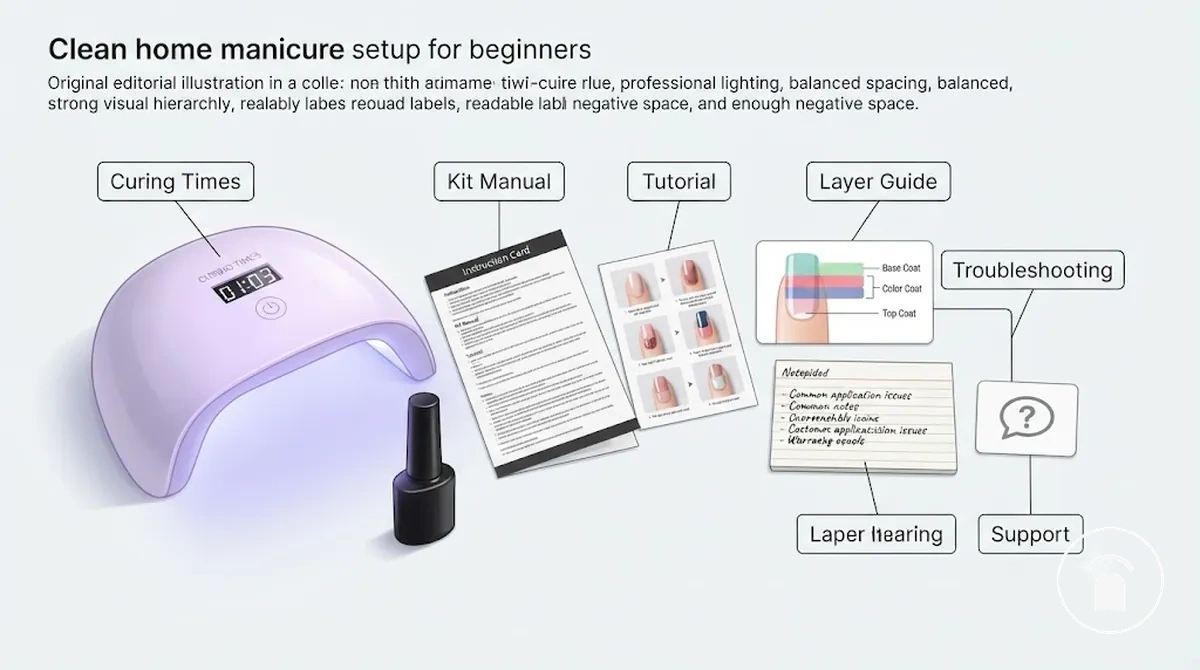
When comparing guidance features, first-time users can check whether the kit provides practical resources that reduce uncertainty during early practice.
- Kit manual: A clear kit manual helps users understand product order and basic requirements, reducing confusion caused by missing guidance.
- Curing times: A visible cure-time chart or curing reference helps users check the expected curing information for the gel polish system instead of estimating times.
- Layer guidance: Layer guidance helps users identify the role of products such as base coat, colour gel, and top coat when the selected system requires separate layers.
- Tutorial support: A tutorial with visual guidance can help users understand the general kit workflow and build confidence through practice.
- Troubleshooting notes: Troubleshooting notes help users review possible causes of common issues instead of assuming every result has the same cause.
- Visible support route: A visible support route, when provided by a specific kit supplier or manufacturer, gives users a clear place to check product-related questions.
Guidance features should be assessed based on what is visibly included or documented for a specific kit. Instructions and tutorials can reduce uncertainty, but they do not guarantee fewer mistakes or a specific result because outcomes still depend on the product system, preparation, curing conditions, and user practice.
Ease-of-Use Features to Compare Before Choosing
Ease-of-use features in a beginner gel nail kit are the design and guidance factors that can reduce uncertainty during first use, including a clear polish system, manageable application tools, suitable lamp design, and instruction quality. Comparing these features helps users identify which conditions support their learning style instead of assuming every convenience feature is necessary.
The table below compares each feature by its beginner-friendly condition, why it matters, and what to check before choosing a kit.
Ease of use depends on how features work together, including the polish system, brush shape, viscosity, lamp design, timer presets, removal simplicity, and instruction quality. The table below compares each feature by its beginner-friendly condition, why it matters, and what to check before choosing a kit.
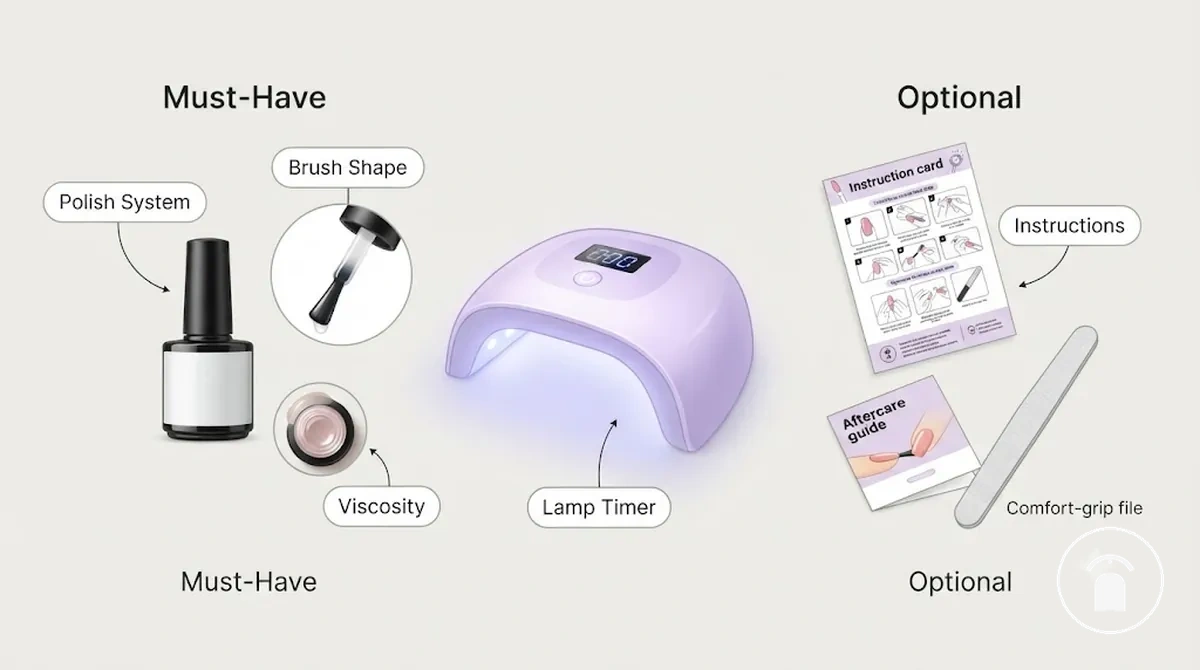
| Feature | Beginner-friendly condition | Why it matters | Watch-out |
|---|---|---|---|
| Polish system | A clear system with compatible layers and usage guidance | Reduces uncertainty about product order and required steps | Different gel systems can require different products and instructions |
| Brush shape | A brush design that allows comfortable product control | Can help users manage application during early practice | Brush preference depends on user technique and comfort |
| Viscosity | A gel consistency that matches the user's preferred level of control | Can affect how easily users place and manage the product | Formula preferences vary between users and application styles |
| Lamp design | A lamp with clear compatibility information and understandable controls | Supports clearer curing guidance when paired with the correct gel system | Lamp requirements depend on the specific gel products being used |
| Timer presets | Visible timer options that match the product guidance | Can reduce uncertainty during the curing stage | Timer settings should follow the kit instructions rather than general assumptions |
| Removal simplicity | A removal method that is explained for the selected gel system | Helps users understand the full product cycle | Removal requirements differ between gel systems |
| Instruction quality | Readable instructions with clear product order and guidance | Reduces guessing during first use | Instruction detail varies between kits |
Must-have beginner criteria usually focus on features that reduce uncertainty, such as compatible products, clear curing guidance, and understandable instructions. Optional convenience features, such as a preferred brush feel or formula preference, may improve comfort but are not required for every user.
Optional convenience features, such as a preferred brush feel or formula preference, may improve comfort but are not required for every user.
Simple users may prioritise fewer decisions and clearer guidance, while practice-focused users may accept more learning during use to develop technique preferences. These trade-offs show why an ease-of-use feature should be evaluated by its condition and beginner effect rather than treated as universally necessary.
These trade-offs show why an ease-of-use feature should be evaluated by its condition and beginner effect rather than treated as universally necessary.
For broader selection criteria beyond ease-of-use features, users can review how to choose a gel nail kit to compare additional factors before selecting a kit.
One-Step Polish Systems Versus Base-and-Top Systems
One-step polish systems and base-and-top systems differ by layer count, with one-step polish combining steps into fewer layers and base-and-top systems using separate products such as base coat and top coat. The main ease-of-use trade-off is between a simpler layer process and the additional finish control that separate layers can provide.
The same manicure goal can require different layer systems depending on the chosen gel formula and user priorities.
The same manicure goal can require different layer systems depending on the chosen gel formula and user priorities. A one-step polish may reduce step burden through fewer layers, while a base-and-top system may provide more control over finish appearance but requires additional product handling. These differences affect curing steps, finish control, and correction difficulty rather than creating a universal advantage for one system.
| System | Beginner trade-off |
|---|---|
| One-step polish | Fewer layers can make the process simpler because separate base coat and top coat steps may not be required. The trade-off is that users may have fewer separate layers to adjust when seeking specific finish characteristics. |
| Base-and-top system | A separate base coat and top coat can provide more layer control and finish options. The trade-off is that the added layers increase the number of steps and curing stages to manage. |
Durability expectations depend on the gel formula, preparation, curing conditions, and application technique rather than layer count alone. A beginner-friendly choice depends on whether the user values a simpler process or prefers the additional control available from a multi-layer system.
Viscosity, Brush Control, and Thin-Coat Application
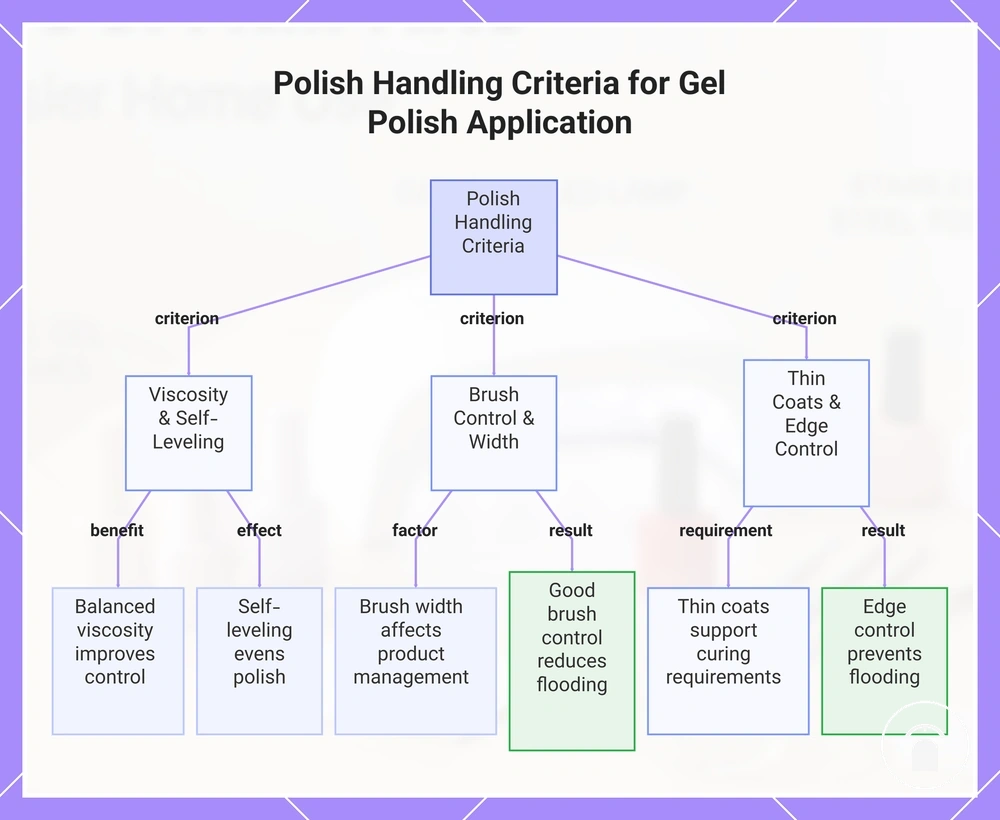
Viscosity, brush control, and thin-coat application are polish handling criteria that affect how easily users can manage gel polish during application. These attributes influence control through factors such as runny polish behaviour, self-leveling, brush movement, coat thickness, and the likelihood of issues such as flooding around the edges.
The following criteria connect each attribute to a condition and the likely benefit or mistake it can help reduce.
Polish handling characteristics can help compare beginner gel nail kit options, but the exact effect depends on the formula and user practice. The following criteria connect each attribute to a condition and the likely benefit or mistake it can help reduce.
- Viscosity: A balanced viscosity can make polish easier to control because very runny polish may move beyond the intended area more quickly. The effect depends on the formula, so viscosity should be assessed as a control factor rather than a guarantee of easier use.
- Self-leveling: Self-leveling behaviour can help polish settle more evenly after placement. The result depends on the gel formula and application conditions, so self-leveling does not guarantee a specific finish.
- Brush width: Brush width affects brush control by changing how much product can be managed in each movement. A brush shape that matches the user's comfort level can support edge control, while an unsuitable width may make precise placement more difficult.
- Brush control: Good brush control helps users manage product placement near the edges of the nail. Limited control can increase the chance of flooding, where excess product moves beyond the intended area.
- Thin coats and coat thickness: Thin coats help users manage coat thickness and follow the curing requirements of compatible gel systems. Applying excessive product in one coat can change how the gel behaves during curing, so product guidance should be followed.
- Edges and flooding: Edge control helps reduce the chance of flooding by keeping product within the intended area. The likelihood of flooding depends on viscosity, brush handling, and the amount of product applied.
These criteria help compare polish handling features, but they do not replace practice. The final result depends on the specific gel formula, product guidance, and user control during application.
These criteria help compare polish handling features, but they do not replace practice.
This chart shows the main polish handling criteria and their specific effects on control and application outcomes.
Lamp Inclusion and Curing Simplicity for Beginners
Lamp inclusion and curing simplicity are important beginner gel nail kit selection factors because gel polish requires a compatible curing lamp to complete the curing process. A kit with a suitable lamp, clear gel polish compatibility information, and understandable curing guidance helps users verify the lamp-polish relationship before use.
A kit with a suitable lamp, clear gel polish compatibility information, and understandable curing guidance helps users verify the lamp-polish relationship before use.
An included curing lamp can reduce uncertainty by keeping the main curing component within the same kit system, but users should still check the lamp type and gel polish compatibility information. A UV lamp or LED lamp should be evaluated alongside the gel products, because curing requirements depend on the specific polish formula and the instructions provided with the kit.
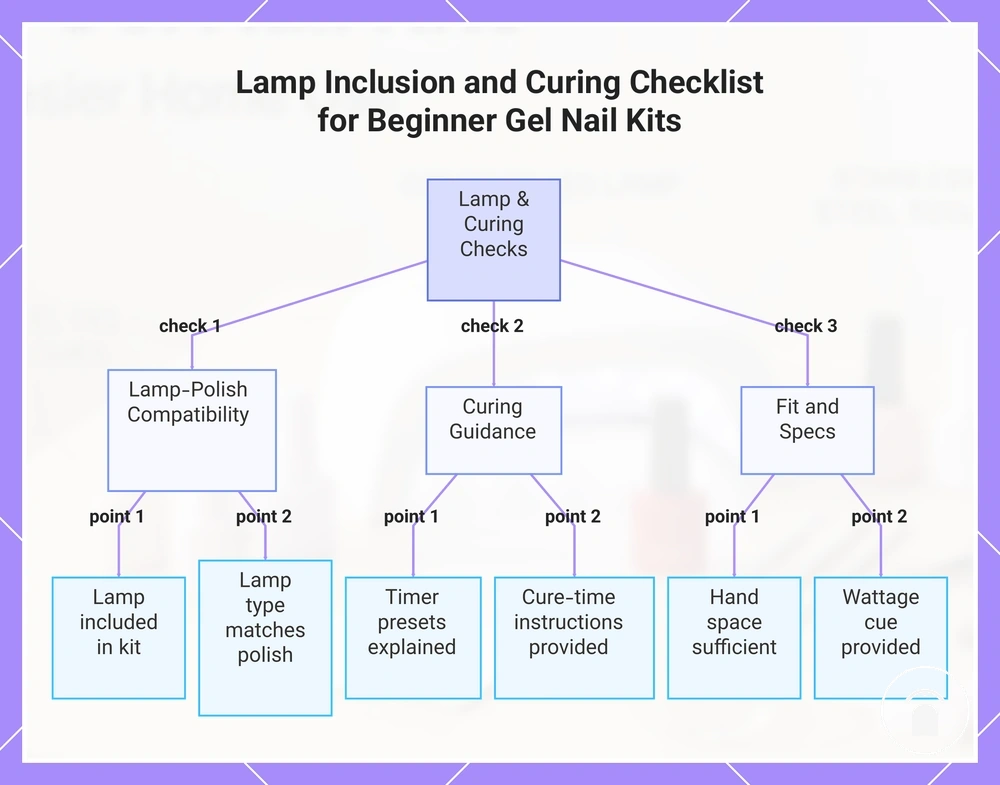
The following checklist helps verify lamp inclusion and curing simplicity features before choosing a beginner gel nail kit.
The following checklist helps verify lamp inclusion and curing simplicity features before choosing a beginner gel nail kit.
- Lamp inclusion: Check whether the kit includes a curing lamp suitable for the included gel polish system. An included lamp can reduce the need to select a separate curing component.
- UV lamp or LED lamp compatibility: Check whether the lamp type matches the gel polish compatibility information. The lamp and gel formula should be considered together rather than separately.
- Gel polish compatibility: Check that the gel polish instructions identify the required curing approach for the included lamp. Compatibility information helps avoid assumptions about which lamp will work with the product.
- Timer presets: Check whether timer presets are clearly explained and connected to the cure-time instructions. Visible timer guidance can make first attempts easier to follow.
- Wattage cue: Check whether the kit provides a wattage cue or lamp specification information. Wattage should be interpreted within the context of the lamp and gel system rather than as a universal rule.
- Hand space: Check whether the lamp design provides enough space for comfortable hand placement, including positioning areas such as the thumb. Smaller lamp designs may require additional attention to fit.
- Cure-time instructions: Check whether the kit provides cure-time instructions for its included products. Users should follow the specific kit guidance rather than applying a general curing time assumption.
Lamp use and broader safety considerations are separate topics from beginner kit selection. This section focuses on verifying lamp compatibility, curing guidance, and fit-related criteria rather than providing a complete lamp safety guide.
Lamp use and broader safety considerations are separate topics from beginner kit selection.
This chart shows the key checks for verifying lamp inclusion and curing simplicity when selecting a beginner gel nail kit.
UV and LED Lamp Cues Without Overcomplicating the Choice
UV lamp and LED lamp cues help beginners verify whether a curing lamp matches the gel polish system they plan to use. These cues help check polish compatibility, lamp label information, and instruction matching rather than selecting a lamp type based on the label alone.
The main comparison point is how each lamp cue helps a buyer interpret compatibility information.
The main comparison point is how each lamp cue helps a buyer interpret compatibility information. A UV lamp or LED lamp label should be considered together with the gel polish instructions because cure-time range, timer guidance, and curing requirements can vary between polish systems.
| Lamp cue | Beginner meaning |
|---|---|
| UV lamp label | Indicates the lamp type information that should be matched with the gel polish compatibility guidance before choosing a kit. |
| LED lamp label | Indicates the lamp type information that should be checked against the gel polish instructions and expected cure-time range guidance. |
A mini lamp can provide convenience for users who prefer a smaller curing lamp design, but hand fit and product instructions remain important checks. The useful selection cue is the match between the lamp label, polish compatibility information, and instruction matching rather than the lamp label alone.
Timer Settings and Cure-Time Guidance for First Attempts
Timer settings and cure-time guidance help beginners reduce uncertainty during first attempts by providing clear controls instead of requiring users to guess curing settings. Preset timers, auto sensor features, and manufacturer instructions help users match curing actions with the selected gel polish system.
Preset timers, auto sensor features, and manufacturer instructions help users match curing actions with the selected gel polish system.
The following checklist shows how timer and guidance cues support more controlled first attempts while keeping timing decisions connected to product instructions.
- Preset timers: Preset timers provide defined control options that can help beginners follow the intended curing guidance instead of estimating timing during first attempts.
- Auto sensor: An auto sensor can help control when the lamp activates based on hand placement, reducing uncertainty around starting the curing cycle.
- Thumb curing: Thumb curing guidance helps users consider hand positioning because thumb placement can differ from other fingers inside some lamp designs.
- Layer-by-layer curing: Layer-by-layer curing guidance helps users understand that timing can relate to the specific layers used in a gel system rather than a single general timing assumption.
- Manufacturer instructions: Manufacturer instructions provide the reference point for cure-time guidance because curing requirements can vary by polish system, layer thickness, and product conditions.
Clear timer settings can reduce guessing, but curing outcomes remain conditional on the selected gel polish system and the manufacturer instructions. Users should use the provided guidance for the specific kit rather than applying a universal timing expectation.
Beginner Suitability by Nail Goals and Practice Level
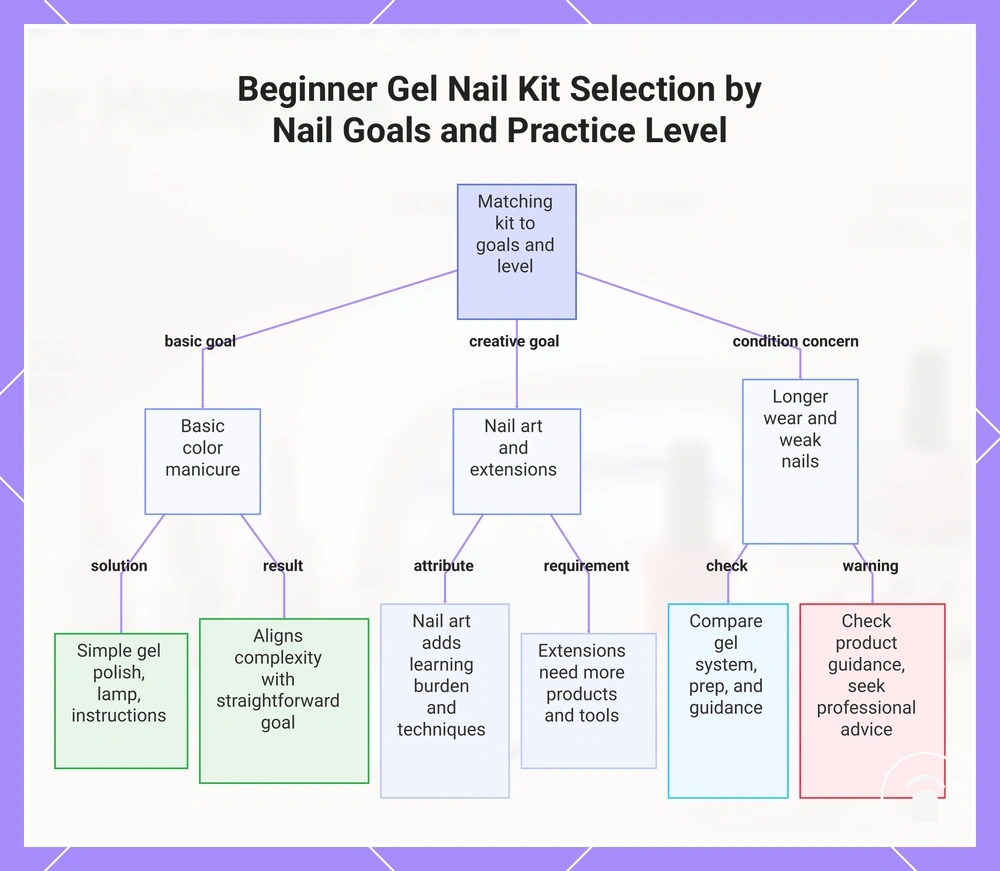
A beginner gel nail kit should match the user's nail goals and practice level because the right kit complexity depends on the intended manicure goal and the user's tolerance for learning. A first-time user seeking a basic colour manicure may need a simpler setup, while a user interested in nail art or extensions may need a kit with more complexity and additional learning requirements.
Practice level affects how much guidance and product complexity a user can comfortably manage.
Practice level affects how much guidance and product complexity a user can comfortably manage. A beginner kit with simple gel polish, a lamp, and clear instructions may suit users learning basic steps, while more advanced goals can involve a greater learning burden and require a willingness to manage additional features.
The following scenarios help match a user goal with kit complexity and selection implications.
The following scenarios help match a user goal with kit complexity and selection implications.
- Basic colour manicure: A user who wants simple gel colour changes may prefer a beginner kit focused on gel polish, curing, and instructions. This selection keeps the kit complexity aligned with a straightforward manicure goal.
- Longer wear: A user prioritising longer wear should compare the gel system, preparation requirements, and product guidance rather than choosing only by the number of included items. Wear outcomes depend on the specific system, application conditions, and user practice.
- Nail art: A user interested in nail art may need to consider a kit that supports additional creative steps. This goal can involve a higher learning burden than a basic colour manicure because more choices and techniques may be involved.
- Weak nails: A user with weak nails should treat nail condition as a reason to check product guidance and use suitable care practices rather than selecting a kit as a solution for a nail concern. Ongoing nail issues may require advice from an appropriate professional.
- Extensions: A user interested in extensions may need a more advanced kit because extension-focused systems can involve additional products, tools, and learning requirements compared with a beginner colour manicure setup.
Choosing the right beginner kit is about matching complexity to the user's goal and current practice level. A simpler kit may suit users learning basic gel polish, while more advanced ambitions may justify a system with additional components and a greater learning commitment.
Choosing the right beginner kit is about matching complexity to the user's goal and current practice level.
This chart shows how to match a beginner gel nail kit to the user's nail goals and practice level, based on five common scenarios grouped into three goal types.
Simple Gel Polish Kits for Basic Colour Manicures
A simple gel polish kit can be suitable for a basic colour manicure when the kit includes the core elements needed for colour application, curing, finishing, preparation, and removal. The right fit depends on the user's goal, with simple kits matching users who want a straightforward manicure rather than additional complexity.
The following checklist shows the core elements that help verify whether a kit matches a basic colour manicure goal.
The minimum feature set for a simple gel polish kit should cover the basic manicure requirements without adding unnecessary steps. The following checklist shows the core elements that help verify whether a kit matches a basic colour manicure goal.
- Colour polish: A simple gel polish kit should include colour polish that matches the user's basic colour manicure goal. This provides the main colour application component without requiring additional specialised features.
- Lamp: A lamp is a core requirement when the gel polish system requires curing. The included lamp should match the colour polish instructions so the user can follow the intended curing guidance.
- Required coats: The kit should include the coats required by its gel polish system. Clear product roles help users understand which layers are needed for the intended manicure.
- Top finish: A top finish supports the final stage of the gel polish system when required by the product instructions. This helps the kit align with a complete basic colour manicure setup.
- Simple prep and removal readiness: A suitable kit should provide or identify simple prep requirements and removal readiness. These elements help users consider the full manicure cycle rather than only the colour step.
A simple gel polish kit is not a lower-quality choice when it matches the user's goal. Users seeking a basic colour manicure may prefer lower complexity, while other nail goals may require different kit features and a different level of preparation.
Advanced Gel, Builder, and Extension Kits That May Be Harder to Start With
Advanced gel, builder gel, and extension kits can be harder for beginners because they add structure-building components that require more control, shaping, and filing skills than a polish-only goal. A more complete kit is not automatically a better beginner choice because kit completeness and beginner suitability depend on the user's intended manicure goal.
Structure-building kits introduce additional decisions compared with simple colour manicure systems.
Structure-building kits introduce additional decisions compared with simple colour manicure systems. Components such as builder gel, polygel, tips, and forms can increase the learning burden because users must manage added product handling, shaping, and finishing requirements.
The following examples show how advanced components can add skill demands and create a higher beginner risk when the user's goal is a simple manicure.
The following examples show how advanced components can add skill demands and create a higher beginner risk when the user's goal is a simple manicure.
- Builder gel: Builder gel adds a structure-building purpose beyond colour application. Beginners may need more practice with shaping and control because the product is used for creating form rather than only applying colour.
- Polygel: Polygel systems can introduce additional handling requirements compared with simple gel polish. The added product control and finishing decisions can increase the learning burden for first-time users.
- Tips: An extension kit that includes tips adds fitting and placement considerations that are not part of a basic colour manicure. This can increase complexity when a beginner is still learning basic gel polish use.
- Forms: Forms add another structure-building component that requires users to manage positioning and shaping decisions. This can create additional skill demands compared with a polish-only goal.
- Drills, shaping, and filing: Advanced kits that involve drills, shaping, or filing add tool-handling requirements and finishing steps. These components can increase beginner risk when the user has not developed the related skills.
Advanced kits may become more suitable when a user's goals move beyond polish-only applications and they are prepared for additional learning. A simpler kit can be a better starting point when the main goal is basic colour application and lower complexity.
Common Beginner Mistakes That Affect Kit Selection
Beginner mistakes can act as selection signals because common problems often relate to prep gaps, thick coats, curing mismatch, or misunderstanding a tacky layer. These mistakes do not always have one cause, but they can help identify whether a kit provides the guidance and features needed for a first-time user.
These mistakes do not always have one cause, but they can help identify whether a kit provides the guidance and features needed for a first-time user.
The table below connects common beginner problems with possible kit-related causes and the selection cues that may reduce uncertainty when choosing a beginner kit.
| Mistake or symptom | Likely kit-related issue | Feature that helps | What it means for selection |
|---|---|---|---|
| Peeling or lifting | May relate to prep gaps when preparation steps or suitable tools are unclear. | Prep tools, cleanser, and instructions | Look for a kit that includes clear preparation guidance as part of the selection criteria. |
| Thick coats or soft polish after curing | May relate to thick coats, coat control, or curing mismatch between the polish system and lamp guidance. | Thin-coat support, lamp guidance, and instructions | Choose a kit with clear product guidance that helps match the lamp and polish system. |
| Confusion about a tacky layer | May relate to finish expectations or unclear instructions about the final gel surface. | Instructions and top coat guidance | Prefer kits that explain the expected finish and role of finishing products. |
| Uneven finish expectations | May relate to choosing a kit without matching the expected result to the included features. | Finish guidance and suitable product information | Match kit selection to the intended manicure goal rather than assuming every system works the same way. |
Common signal patterns can guide kit selection: prep gaps may point toward the value of preparation tools, while thick coats and curing mismatch may point toward clearer lamp guidance and instructions. These signals support choosing a suitable beginner kit but do not replace a dedicated troubleshooting process for specific application problems.
For broader help with unresolved issues, users can review common beginner problems as a separate troubleshooting resource.
For broader help with unresolved issues, users can review common beginner problems as a separate troubleshooting resource. A suitable kit can reduce uncertainty through better guidance and appropriate components, but it cannot prevent every beginner mistake.
Prep, Thick Coats, and Curing Mismatches
Prep gaps, thick coats, and curing mismatch are common beginner problems that can affect gel nail results, and they can also act as selection signals when choosing a beginner kit. These issues do not have one guaranteed cause, but preparation support, coat guidance, and curing information can help reduce uncertainty during kit selection.
The following local signals connect an action gap with a possible symptom and the kit feature or instruction that may help reduce the risk.
The following local signals connect an action gap with a possible symptom and the kit feature or instruction that may help reduce the risk.
- Prep gaps and surface shine: A preparation gap, such as not following the product guidance for surface preparation, may contribute to symptoms such as peeling or lifting. A kit that includes cleanser guidance and suitable preparation tools can be a useful selection cue.
- Cleanser use: Unclear cleanser guidance may create uncertainty during preparation steps. A beginner kit with clear instructions about cleanser use can help users understand the preparation requirements of the system.
- Thick coats and thin layers: Thick coats may contribute to curing problems such as softness when the product layer does not cure as expected. Kits that explain thin layers and coat guidance can provide a clearer starting point for beginners.
- Curing mismatch and lamp compatibility: A curing mismatch may occur when lamp compatibility information is unclear for the selected gel system. A kit with clear lamp compatibility guidance can help users select components that are intended to work together.
- Cure time and thumb positioning: Unclear cure time guidance or thumb positioning can create uncertainty during curing. Manufacturer instructions that explain timing and positioning conditions can help users interpret the requirements of their specific kit.
These signals are selection cues rather than a complete correction workflow or a full diagnosis of application problems. Users should follow the specific kit instructions because preparation requirements, coat thickness guidance, lamp compatibility, cure time, and thumb positioning can differ between gel systems.
Tacky Layers and Finish Expectations
A tacky layer can be an expected part of some gel systems, but its meaning depends on the product layer and the instructions provided with the kit. Beginners should distinguish a normal inhibition layer from finish observations that may require checking the gel system guidance.
Beginners should distinguish a normal inhibition layer from finish observations that may require checking the gel system guidance.
The final finish depends on the combination of gel layers used, including whether a no-wipe top coat is applied or whether cleanser is required after curing. Because gel systems differ, finish expectations should be interpreted according to the specific kit instructions rather than a universal rule.
The following observations help separate normal finish behaviour from signs that may need further checking.
The following observations help separate normal finish behaviour from signs that may need further checking.
- Tacky layer or inhibition layer: Some gel systems leave an inhibition layer after curing as part of the normal product behaviour. If the instructions describe this layer, a tacky surface may be an expected condition rather than a failure signal.
- No-wipe top coat finish: A no-wipe top coat is designed for a different final finish expectation than systems that require cleanser. The correct interpretation depends on whether the selected gel system includes a cleanser step.
- Cleanser requirement: A remaining tacky residue may be expected when a gel system requires cleanser after the final layer. Users should check the product instructions to understand whether cleanser is part of the intended finishing process.
- Dull finish: A dull finish may indicate that the final surface does not match the expected result for that gel system. The observation should be interpreted alongside the product layers, instructions, and finish expectations.
- Uncured-feeling polish: Soft or uncured-feeling polish can be a sign that the curing conditions or product instructions need checking, but it does not identify one exact cause without considering the gel system and application conditions.
Understanding tacky layers helps beginners avoid misreading normal gel behaviour as a problem. When the finish does not match the expected result, the kit instructions provide the most relevant reference because layer types and final finish behaviour vary between gel systems.
When a Beginner Kit Is Worth Choosing
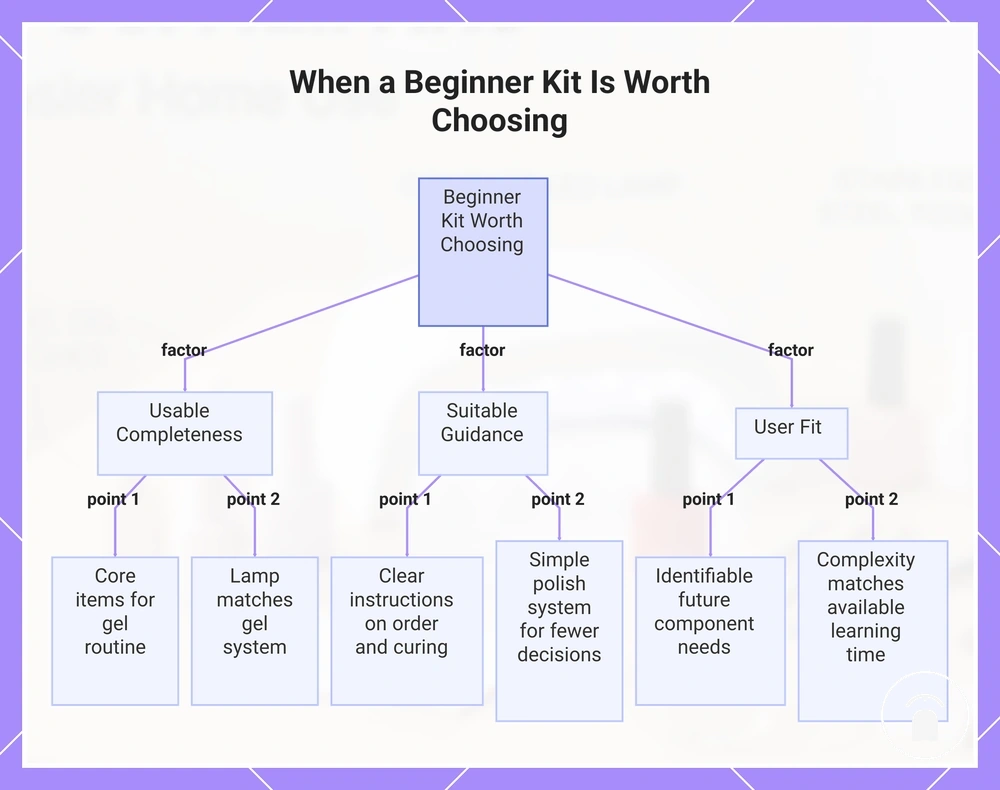
A beginner kit is worth choosing when it provides usable completeness for the user's goal through included essentials, suitable guidance, and a level of complexity that matches expected use. The value of a beginner kit comes from how well the included components support a practical starting setup rather than from being the lowest-price option.
A beginner kit's cost-value depends on the relationship between its features and the user's needs.
A beginner kit's cost-value depends on the relationship between its features and the user's needs. A kit can provide value when it reduces the need to combine separate tools, clarifies the gel system, and supports the user's expected learning time.
The following checklist connects each feature to a value condition and a selection outcome.
The following checklist connects each feature to a value condition and a selection outcome.
- Included essentials: A beginner kit provides usable completeness when it includes the core items required for the intended gel polish routine. This can make the kit more suitable for users who want a ready-to-start setup rather than selecting separate components.
- Lamp adequacy: A beginner kit gains value when the included lamp matches the gel system requirements. Clear lamp adequacy information helps users assess whether the curing component fits the included products.
- Instruction quality: A kit provides more beginner value when its instructions explain product order, curing guidance, and basic expectations. Clear instructions can support beginner confidence by reducing uncertainty during early use.
- Polish simplicity: A beginner kit can be worthwhile when the polish system matches a user's goal for a straightforward manicure. A simpler polish system may suit users who want fewer decisions during the learning stage.
- Replacement needs: A kit's long-term value depends on whether users can identify future component needs. Understanding replacement needs helps users judge whether the kit fits expected use beyond the first application.
- Learning time: A beginner kit may be worth choosing when its complexity matches the user's available learning time. A kit with a suitable learning curve can provide better value when it aligns with the user's commitment to practice.
The trade-off is that a more complete kit is not automatically the right choice for every beginner. A suitable choice depends on the balance between usable completeness, kit contents, likely use frequency, learning time, and whether the features match the user's goal rather than on price claims or rankings.
Reviewing how to choose a gel nail kit can help compare these factors before making a selection.
A beginner kit is worth choosing when its value comes from the right combination of completeness, fit, and manageable complexity. Reviewing how to choose a gel nail kit can help compare these factors before making a selection.
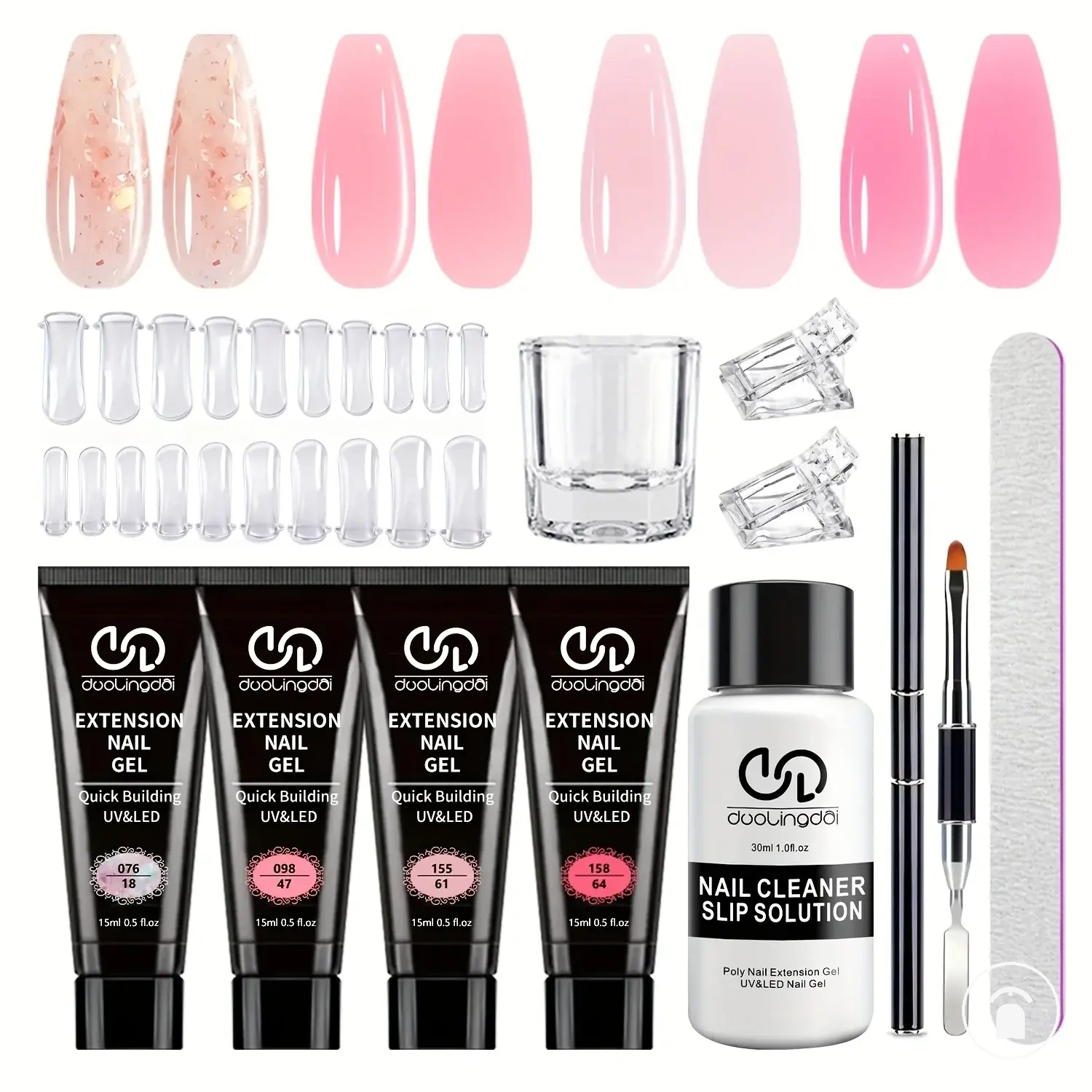
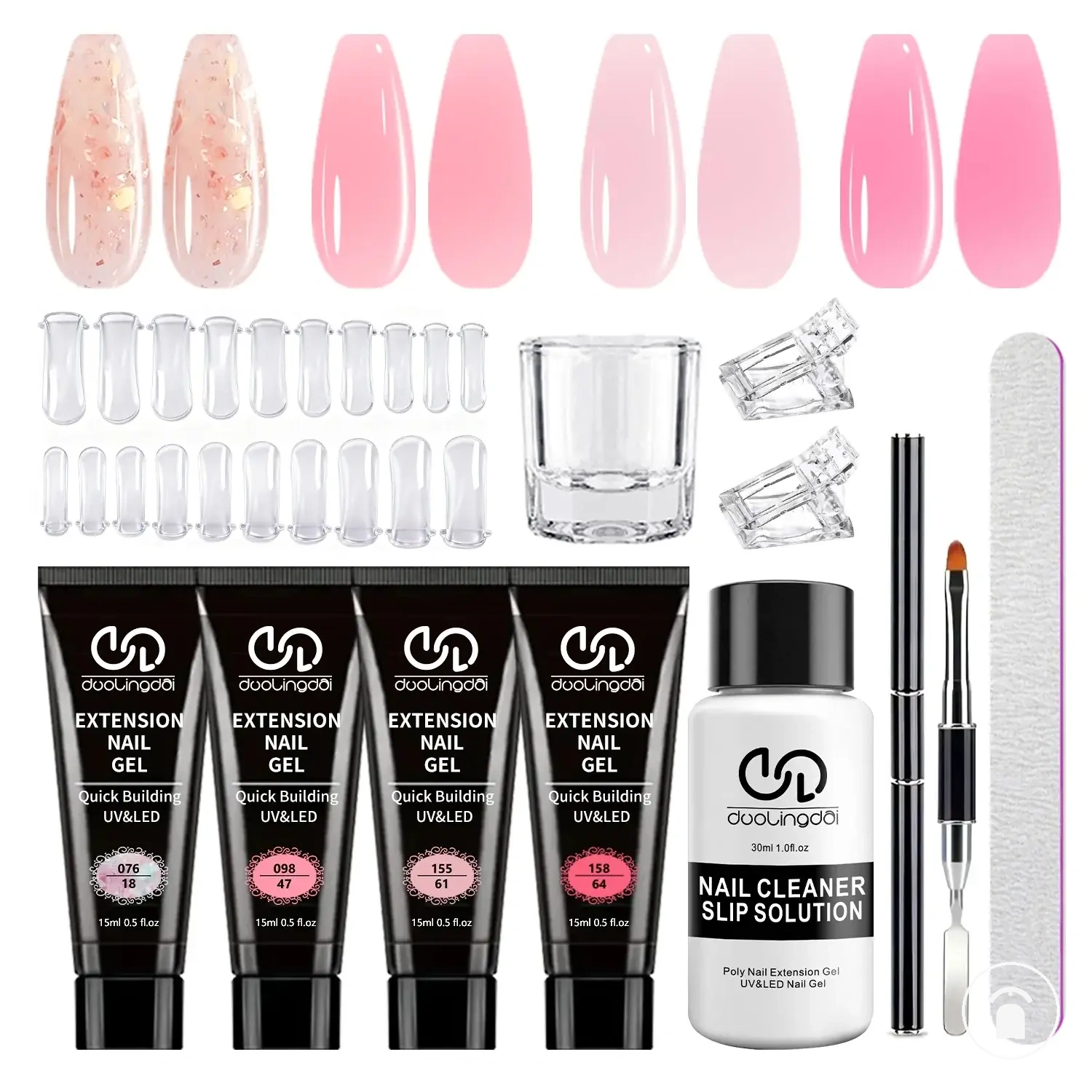
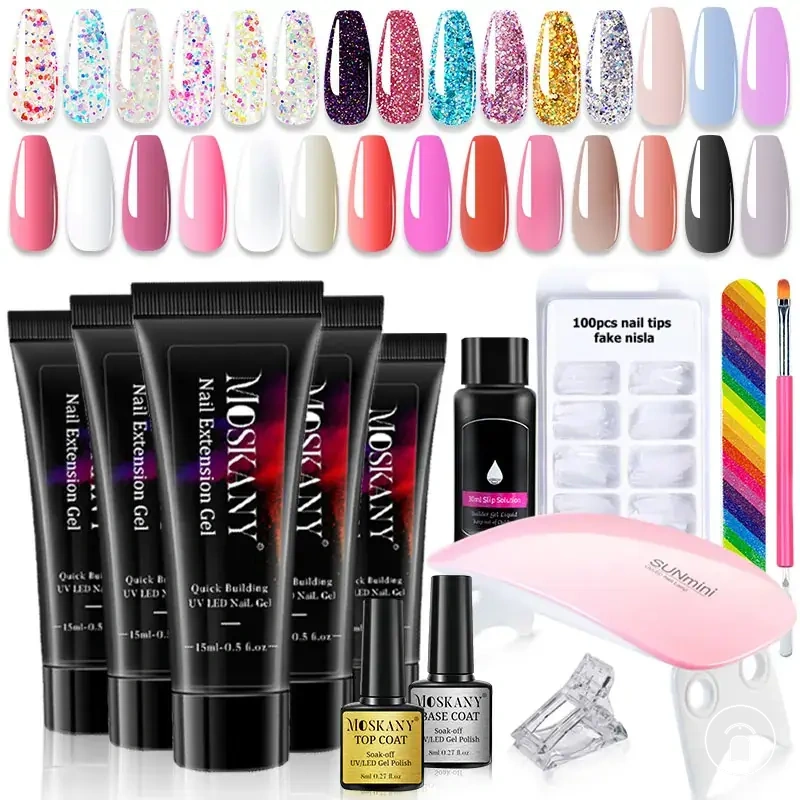
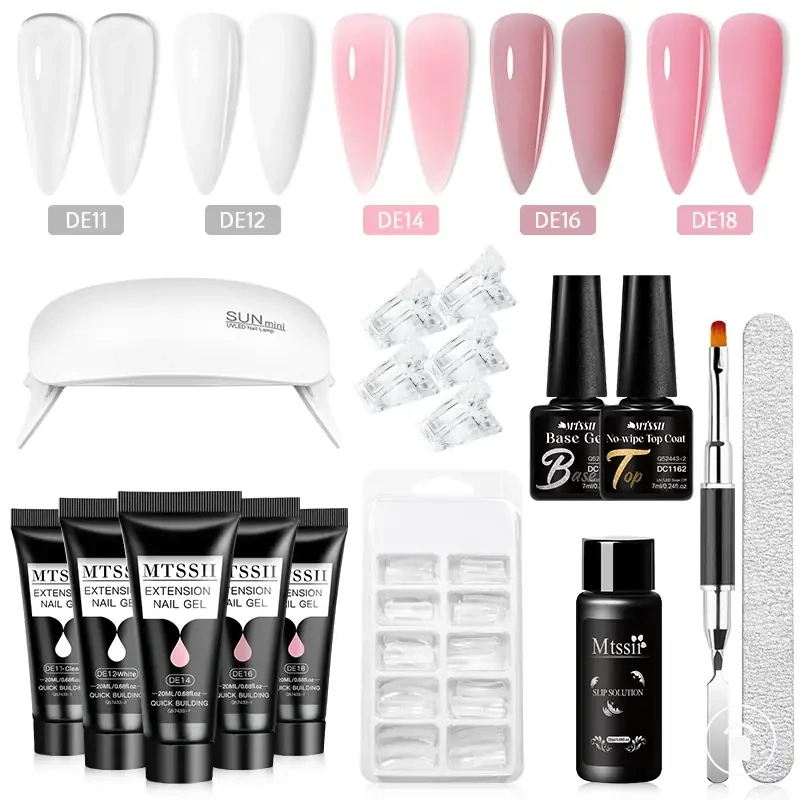
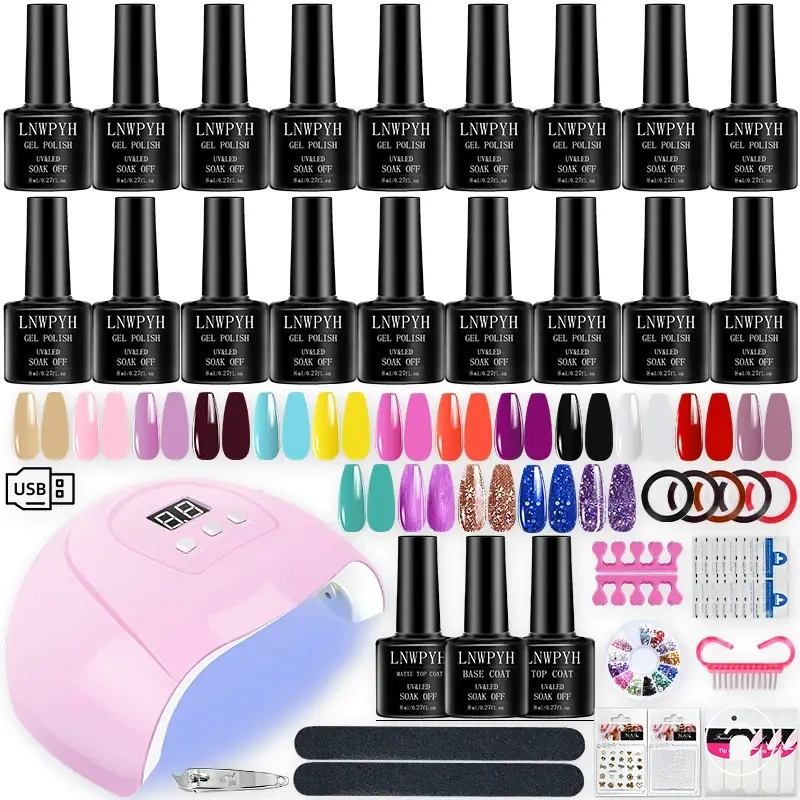
Here are product examples that may make comparison easier.
Here are product examples that may make comparison easier. Before buying, always review the compatibility criteria, essential features, and product details.
This chart shows the key factors that determine whether a beginner gel nail kit provides real value, based on completeness, guidance, and user fit.
Beginner Kit Limits That May Require a Better Option
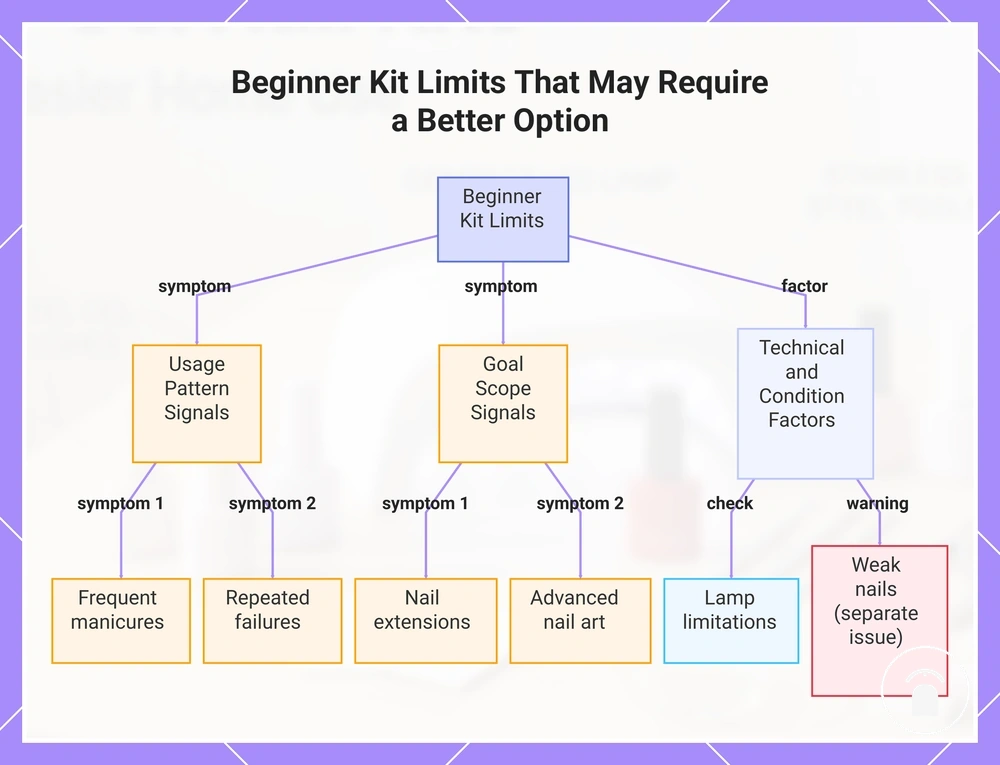
A beginner kit may require a better option when the user's goals no longer match the kit's intended scope, such as frequent manicures, nail extensions, advanced nail art, or repeated application problems. These beginner kit limits are fit signals that help users decide whether their needs have changed rather than signs that the kit is defective.
Some users may outgrow a beginner kit when they need features, capacity, or flexibility beyond a simple starting setup.
Some users may outgrow a beginner kit when they need features, capacity, or flexibility beyond a simple starting setup. Frequent manicures can make replacement needs and lamp limitations more relevant, while goals such as nail extensions or advanced nail art can introduce additional skill demands.
Weak nails and repeated failures require careful interpretation because they can involve multiple contributing factors.
Weak nails and repeated failures require careful interpretation because they can involve multiple contributing factors. A better option depends on the user's goal, kit design, instructions, curing conditions, and whether the current limitation relates to the system's intended use.
The following scenarios show common upgrade signals where a beginner kit may no longer provide the right fit.
The following scenarios show common upgrade signals where a beginner kit may no longer provide the right fit.
- Frequent manicures: Users completing frequent manicures may find that replacement needs and repeated use expectations become more important. A kit limitation may indicate that a different setup better matches the user's usage pattern.
- Nail extensions: Users interested in nail extensions may exceed the scope of a basic beginner kit because extensions can involve additional structure-building products and skill demands. A better direction may be a system designed around that goal.
- Weak nails: Users concerned about weak nails should consider nail condition separately from kit selection. A beginner kit may not address every nail concern, so the appropriate next step depends on the specific situation.
- Advanced nail art: Users pursuing advanced nail art may find that a simple beginner kit does not provide the level of creative flexibility they want. The next-step option depends on the techniques, tools, and learning commitment involved.
- Lamp limitations: Users experiencing lamp limitations may need to reassess whether the curing component matches their gel system and intended use. Compatibility and guidance remain important boundary conditions.
- Repeated failures: Repeated failures may signal a mismatch between user expectations, instructions, curing conditions, or kit scope. A better option may involve a system that better aligns with the user's needs.
Outgrowing a beginner kit can be a normal part of matching tools to changing goals. The practical decision is to identify the specific limitation, then choose a better option only when that limitation affects the user's intended use and future learning path.
Outgrowing a beginner kit can be a normal part of matching tools to changing goals.
Here are product examples that may make comparison easier. Before buying, always review the compatibility criteria, essential features, and product details.
This chart shows the common scenarios where a beginner gel nail kit may no longer meet the user's needs, helping identify when an upgrade is appropriate.